The main goal of iDLS-Demo is to develop, construction and qualification for space of a commercial instrument for visual navigation, automated obstacles detection and safe landing site selection (iDLS), in preparation for its integration and in-orbit demonstration in a real lunar landing mission.
PROJECT DESIGNATION | iDLS-DEMO |
|---|---|
PROJECT CODE | COMPETE2030-FEDER-01204300 |
MAIN OBJECTIVE | The project aims to develop, build, and qualify a commercial instrument for visual navigation, automatic obstacle detection, and landing site selection (iDLS) for deep space operation, with a view to its integration and flight in a real mission. The hardware is derived from a Spin.Works instrument currently in orbit (the hyperspectral camera of the AEROS nanosatellite and its processor), where visual navigation and automatic landing site selection algorithms already developed in the context of successive contracts with the European Space Agency over more than 10 years will be implemented, and whose maturity is at TRL 4-6. The instrument will be exhaustively tested using simulation, laboratory tests with a robotic arm and scaled terrain, and in flight over representative terrain aboard multicopters. The instrument will be used to support the descent and planetary landing of private and institutional missions, and has significant economic potential in the emerging space exploration market.
The project will conclude with the installation of the instrument aboard a real mission of a US partner (Orbit Beyond Inc.), on a vehicle that will carry out a lunar landing mission during the year 2027, which will then result in a TRL of 9.
Regarding this project, it is worth noting the letters of recommendation issued by both ESA and Orbit Beyond Inc., which indicate its relevance to the sector. |
APPROVAL DATE | 05-09-2024 |
BEGIN DATE | 04-11-2024 |
CONCLUSION DATE | 31-10-2026 |
TOTAL COST | 1 618 968 EUR |
FINANCIAL SUPPORT FROM EU | Compete2030 – 1 264 856,65 EUR |
The project aims to develop, build, and qualify a commercial instrument for visual navigation, automatic obstacle detection, and landing site selection (iDLS) for deep space operation, with a view to its integration and flight in a real mission.
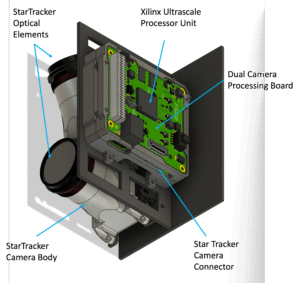
The hardware is derived from a Spin.Works instrument currently in orbit (the hyperspectral camera on board the AEROS nanosatellite along with its payload data processor), whereas visual navigation and automatic landing site selection algorithms developed over the course of more than one decade, including in the context of successive contracts with the European Space Agency, will be implemented. These algorithms are currently at TRL 4-6.
The instrument will be exhaustively tested using simulation, laboratory tests with a robotic arm and scaled terrain, and in flight over representative terrain aboard multicopters. The addressable market for the proposed instrument includes most private and institutional missions involving planetary descent and landing – in the short term, Moon and Mars. The potential of this instrument in the emerging space exploration market cannot be understated.
intelligent Descent and Landing System (iDLS) – Key Capabilities
The project will conclude with the installation of the instrument aboard a real mission of a US partner (Orbit Beyond Inc.), on a vehicle that will carry out a lunar landing mission during 2027, which will then result in a TRL of 9.
Regarding this project, it is worth noting the letters of support issued by both ESA and Orbit Beyond Inc., which indicate its relevance to the sector.
Rua de Fundões 151, 3700-121 São João da Madeira, Portugal
Av. da Igreja 42, 6º, 1700-239 Lisboa, Portugal